Daniel 11b

Daniel 11: The Most Detailed Prophecy in the Bible
The prophecy of Daniel 11 includes amazing details about great empires, political developments and end-time powers that would affect the Jews and all people today.
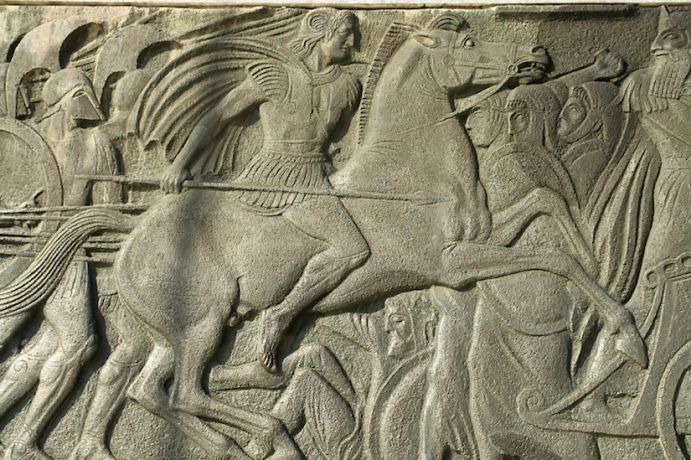
Alexander the Great’s empire and its divisions after his death were predicted long in advance in Daniel 11.
Introduction to Daniel 11
The introduction to the prophecy of Daniel 11 is given in the preceding chapter. This introduction is quite extensive—all of Daniel 10.
It begins: “In the third year of Cyrus king of Persia a message was revealed to Daniel, whose name was called Belteshazzar. The message was true, but the appointed time was long; and he understood the message, and had understanding of the vision” (Daniel 10:1).
According to The Expositor’s Bible Commentary, the third year of Cyrus was “535/534, in all probability just a few years before Daniel’s death” (comment on Daniel 10:1). Through Nebuchadnezzar’s dreams (Daniel 2:1) and through Daniel’s vision of four beasts (Daniel 7), God had already revealed that there would be four world-ruling empires followed by the Kingdom of God.
Now God was going to reveal to Daniel some amazing details about major world powers, beginning with the Medo-Persian Empire and continuing through the time of the end just prior to Christ’s second coming. The angel that came to help Daniel understand the vision told him that its focus was on “what will happen to your people in the latter days, for the vision refers to many days yet to come” (Daniel 10:14).
What would happen to the people of God both in Daniel’s time and in the future was of great interest to him, as by then 42,360 Jews had returned to Jerusalem following a decree by Cyrus allowing them to go back to their homeland (Ezra 2:64).
When was the book of Daniel written?
The years Daniel mentions put this prophecy around 535 B.C. This was the third year of Cyrus (Daniel 10:1) and was after the event the angel mentioned to Daniel that happened in the first year of Darius (Daniel 11:1; around 539 B.C.). We believe the biblical account is true, but some question the dating.

But foretelling the future is not difficult for God. As God stated, “For I am God, and there is no other; I am God, and there is none like Me, declaring the end from the beginning, and from ancient times things that are not yet done” (Isaiah 46:9-10, emphasis added throughout).
Fulfilled prophecy in Daniel
Since other prophecies found in the book of Daniel, such as the 70-year prophecy of Jeremiah and the 70-weeks prophecy (indicating the year of the appearance of the Messiah), were fulfilled exactly as predicted, we can have confidence that God also provided the details found in this prophecy in Daniel 11 long before they took place. For further study of fulfilled prophecy, see “Fulfilled Prophecy Is Evidence of God’s Existence” and “Daniel’s Prophecies: Proof of God’s Existence.”
The initial aspects of the prophecy of Daniel 11 have taken place precisely as God predicted. A comparison of secular history with the biblical record will reveal the fascinating details. Other parts, including the identity of the end-time king of the North and the end-time king of the South, are yet to be fulfilled. These unknown portions of the prophecy have been sealed “until the time of the end” (Daniel 12:4).
An interesting point regarding this prophecy is that it appears to have been delivered orally. Unlike the preceding dreams and visions in the book of Daniel, which contained images that needed to be interpreted, this vision simply gave Daniel the “words” regarding what would happen to the Jewish people from this time forward (Daniel 10:7, 9).
The Medo-Persian Empire to be conquered by Greece
The prophecy of Daniel 11 begins with the prediction that “three more kings will arise in Persia” followed by a fourth who would “stir up all against the realm of Greece” (verse 2).
Biblical resources, such as The Expositor’s Bible Commentary, provide the historical explanations for this prophecy. Regarding this verse, Expositor’s states, “The Persian king who invaded Greece was, of course, Xerxes, who reigned 485-464 B.C.”
Daniel 11:3-4 speaks of the appearance of “a mighty king,” whose kingdom would “be broken up and divided toward the four winds of heaven.”

Expositor’s explains, “Verse 3 introduces us to the next phase in world empires: the rise of Alexander the Great. Although this verse does not make it altogether clear that this ‘mighty king’ would inaugurate a new empire in place of the Persian one, verse 4 leaves us in no doubt that he was the ruler predicted here. …
“In seven or eight years he accomplished the most dazzling military conquest in human history. But he lived only four years more; and after one of his drunken bouts, he died of a fever in 323 in the imperial capital of Babylon. Verse 4 foretells the division of Alexander’s domains among four smaller and weaker empires.”
Alexander the Great’s empire divided
Following Alexander’s death, his empire was divided among four of his generals. These four kingdoms and their rulers were Macedonia-Greece under Antipater and his son, Thrace–Asia Minor under Lysimachus, the rest of Asia except lower Syria and Palestine under Seleucus Nicator, and Egypt and Palestine under Ptolemy.
The remainder of Daniel 11:5-39 then documents the actions of the last two of these kingdoms—Egypt to the south of Jerusalem (the location of Daniel’s people, the Jews, Daniel 10:14) and Syria to the north of Jerusalem. In this section of Scripture the rulers and their successors are referred to as the “king of the North” and the “king of the South.”
Who is the king of the North?
So in Daniel 11, the king of the North refers to the successors to Seleucus ruling north of the Holy Land.
As we will see, the Seleucid kingdom was later defeated by the Roman Empire, and it seems the end-time fulfillment of the king of the North will be a revival of the Roman Empire. See our article “The King of the North” for more on this.
Who is the king of the South?
In Daniel 11 the king of the South refers to the successors to Ptolemy who ruled from Egypt, south of the Holy Land.
As our article “The King of the South” shows, the end-time king of the South may represent the leader of a confederacy of Arab nations or a powerful Arab nation. As it was historically, Egypt will likely be involved (Daniel 11:42).
Before getting to the end-time prophecies, consider the amazing detailed prophecies fulfilled during the centuries after Daniel wrote. The following commentary on Daniel 11 summarizes many of those details.
Daniel 11 explained: the king of the North versus the king of the South
Located geographically between ambitious kingdoms to the north and south, the Jewish people during postexilic times were often caught in the rivalries for power between Egypt and Syria. While space does not permit a detailed explanation of every verse in Daniel 11:5-39 and its historical fulfillment, here are a few highlights:
Verse 5: Expositor’s explains, “‘The king of the South’ (verse 5) was to be Ptolemy I (Soter), son of Lagus, whose ambitions extended far beyond the borders of Egypt (over which Alexander had placed him in charge) to Palestine and the rest of Asia.”
When we consider the many

Comments
Post a Comment